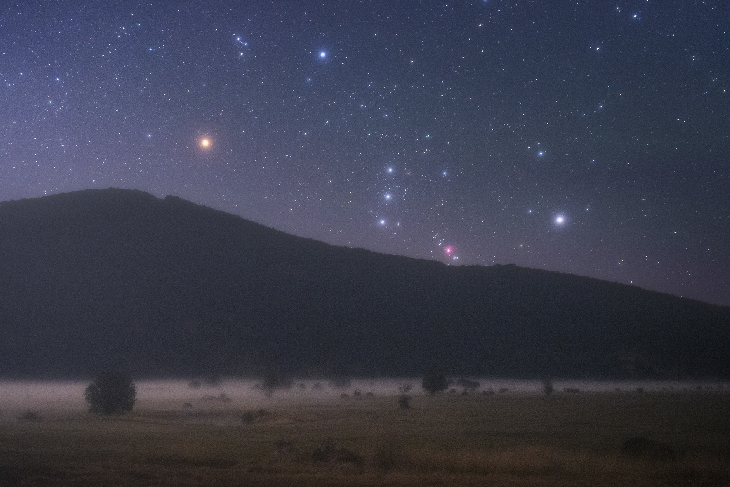
Orion
Taken by Ondrej Kralik on August 13, 2023 @
Mazin, Croatia
Click photo for larger image

| |
Camera Used: Canon Canon EOS 6D
Exposure Time: 15/1
Aperture: f/2.0
ISO: 3200
Date Taken: 2026:10:01 09:01:17
|
|
| More images
Details:
Do you see that red spot in the middle? A sensor defect? Color noise?
Neither.
It is M42 – the Great Orion Nebula, one of the brightest nebulae in the night sky, and under good conditions, it can even be seen with the naked eye.
It is a huge region of gas and dust where new stars are being born. So that small red patch in the photograph is actually a vast stellar nursery located about 1,300 light-years away.
As winter approaches, Orion rises higher in the night sky and becomes one of the most prominent constellations of the winter sky. Autumn and early winter also bring the typical morning fogs, which can beautifully separate the landscape from the dark silhouette of the mountains.
That night, the landscape was also gently illuminated by a thin crescent Moon. Its faint light also illuminated the atmosphere, giving the sky its characteristic bluish tint. That is why the image doesn't show a completely black night sky.
And this is exactly what I love about astrophotography – a camera can capture things that to the naked eye often look like nothing more than an inconspicuous point of light in the sky.
👉 https://www.kralikondrej.com/
FACEBOOK: https://www.facebook.com/profile.php?id=100009914253842
INSTAGRAM: https://www.instagram.com/ondrejkralikastro/
📍 13. 8. 2023, Mazin, Croatia
📷 Canon 6D + Sigma 50mm, f/1.4@f2.0, 15sec, 3200, Single shot. Tripod: Innorel RT80C
Photographer's website:
https://www.kralikondrej.com
|
|
|