| More images
Details:
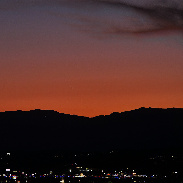
The official (i.e. no mountains to contend with) sunset time was at 7:26 (all times pm MDT). I first spotted Mercury in 7x35 binoculars 24 minutes later at 7:50 near the end of civil twilight and started the timelapse at 7:56. It set behind the mountains only 8 minutes later at 8:03pm, and even for a flat horizon it would have set at 8:12pm. Sadly this is about as high as it ever gets during its current evening apparition (~3° above a flat horizon at the end of civil twilight for latitude 37° N., anyway). I did not see it naked-eye. It reaches greatest elongation from the Sun on Oct 11 at 25° east; maybe someone can spot it with the naked eye then.
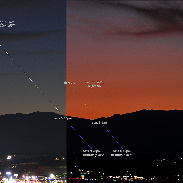
Also, Spica was closest to Mercury tonight at 58 arcseconds below and to its left, but there was no hope of seeing it against the bright sky. The star set higher on the mountain (hence sooner), but I'm pretty sure it was above the mountain peaks for a couple minutes before then, judging from Mercury's position when the timelapse started. Even to see Mercury against the bright sky I had to enhance its images (mostly by making them bigger) to make them clearly visible in the photo.
Images:
... #1: Mercury timelapse by itself
... #2: Composite of timelapses: Sep 7, 17, 25 with Venus, Spica, & Mercury
Photo data:
Panasonic GX8, Lumix 100-300mm lens @ 100mm, tripod
... 29 frames x (f/4, 1/30 -> 1/15 sec, ISO 200
... cadence: 15 sec; timespan: 7:56pm-8:03pm MDT
... timelapse stacking in startrails.exe, editing in Paint Shop Pro 2023
... date: Sep 25, 2026
Photographer's website:
No URL provided.
|